I've Lived in Minneapolis All My Life: My Honest Pros and Cons

I’ve lived in Minneapolis for 49 years, through 30-below winters, tax hikes, and a downtown where buildings now sell for a fraction of what they once did. After decades in real estate, here’s my honest take on what’s great, what’s frustrating, and who really thrives here.
Figures below are as of my video above (January 2026).
What I love: the lakes and parks
One of the most visited spots around here isn’t a casino or a theme park. It’s a chain of lakes you can bike to from your house in ten minutes.
- 22 lakes inside Minneapolis city limits, and Lake Minnetonka (almost 15,000 acres) about 15 minutes west.
- The Chain of Lakes Regional Park links five lakes with more than 13 miles of trails.
- The Grand Rounds National Scenic Byway: about 50 miles of connected trails around the city.
- Theodore Wirth Park: 759 acres of mountain biking, golf and groomed cross-country ski trails.
- More than 180 parks covering over 6,800 acres.
- St. Anthony Falls, the only natural major waterfall on the Mississippi, and Minnehaha Falls, a 53-foot waterfall with over 850,000 visitors a year.
You can live downtown and be around farm fields in 30 minutes.
What surprises people: the economy
Target, 3M, General Mills, UnitedHealth Group, U.S. Bancorp and Best Buy aren’t just Minnesota brands. They’re Fortune 500 global headquarters, part of the 17 Fortune 500 companies here. We also have Cargill, the largest privately held company in the world. Health care and financial services are huge, with Medtronic, Boston Scientific and Wells Fargo running major operations.
Unemployment has averaged about 3% to 3.6%, and the metro has over 3 million workers. MSP Airport is Delta’s second-largest hub, with more than 330 peak-day departures to 124 destinations. You can fly nonstop to Japan, Amsterdam or almost anywhere in the U.S., and I love not having connections.
The cost of living is reasonable
When I made the video, the median home price was about $350,000 in Minneapolis and $290,000 in Saint Paul, roughly 20% below the national average, with homes selling in about 23 to 26 days. Overall, housing costs run about 18% below the national average, health care about 5% lower and transportation about 3% lower. That’s roughly 25% cheaper than Chicago and 40% cheaper than San Francisco.
The catch: taxes
Minnesota has one of the highest tax burdens in the country, about 9.4%, ranking 8th. The top state income tax rate is 9.85%. Minneapolis property taxes average about 1.3% of value, compared with about 1% nationally, so a $350,000 home pays roughly $4,200 to $4,500 a year, and the city approved another 6.9% levy increase. Strong wages help carry it, but plan for it. (See property taxes by city.)
What I don’t love
- Winter. We’re the coldest major metro in the continental U.S., with over 50 inches of snow a year. January lows average 4 to 8°F, and wind chills can hit -30°. At the winter solstice we get about 9 hours of daylight, and the sun sets around 4:30. Seasonal depression is common. Snow can stay on the ground from late November to early April. Road salt also rusts cars fast.
- Downtown’s struggles. Commercial buildings have lost huge value; one that sold for about $200 million less than a decade ago recently sold for $6.25 million. Downtown needs major investment beyond the Twins, Vikings and Timberwolves.
- Constant road construction. MnDOT had about 180 projects statewide, more than 50 in the metro.
- State budget swings, from a record $17.5 billion surplus to a projected deficit of nearly $6 billion later in the decade.
- Summer mosquitoes, especially near the lakes we love. People joke they’re the unofficial state bird.
Who thrives here
If pond hockey on Lake Nokomis (home of the U.S. Pond Hockey Championships) sounds like paradise rather than punishment, you’ll probably love it here. People who do best:
- Embrace all four seasons: skiing, skating, ice fishing, snowshoeing, hockey, snowmobiling.
- Work in health care, finance or corporate roles, with so many headquarters here.
- Love arts and culture: the Guthrie, the Walker and the Minnesota Orchestra.
People who struggle tend to be those who can’t handle the cold, need lots of sunshine, or need a New York- or Chicago-level transit system. Ours is good, but not that.
Why I’m excited about the future
- The Green Line Extension ($2.9 billion, about 85% complete) opens in 2027, with 16 stations from downtown through St. Louis Park, Hopkins and Minnetonka to Eden Prairie.
- The Blue Line Extension will connect north Minneapolis to Brooklyn Park with 13 stations by 2030.
- MSP is investing $575 million in 2025 improvements, including concourse expansions.
- Downtown’s plan represents $4.8 billion in private investment, focused on turning offices into homes, with more than 10,000 new housing units.
- The metro is projected to grow by about 650,000 people through 2050.
- Highland Bridge in Saint Paul is redeveloping the old Ford plant site.
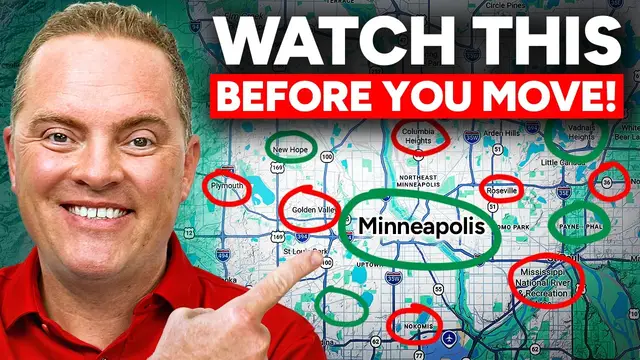
Neighborhoods and suburbs worth a look
- St. Louis Park gets four Green Line stations in 2027.
- North Loop and the Warehouse District: converted warehouses near Target Field and restaurants like Bar La Grassa and Spoon and Stable.
- Northeast Minneapolis: art studios, craft breweries and a growing food scene.
- Uptown: walkable shops near Bde Maka Ska.
- Wayzata: Lake Minnetonka access and a charming downtown.
- Edina: a median around $630,000 and the Southdale area.
- Eden Prairie: parks, and Green Line access coming in 2027.
- Lakeville: up 9.7% in population since 2020, at moderate prices.
- Hidden gems: Longfellow and Seward in south Minneapolis, and residential Northeast beyond the brewery district, for more affordable options.
Downtown, the skyway connects more than 150 buildings across about 10 miles, so you can live, work, shop and eat without going outside in winter.
The honest bottom line
Minneapolis isn’t for everyone. The winters will test you, and the taxes take a bite. But for someone who embraces four seasons and wants to be part of a community building something special, it’s hard to beat. Email our team for one-on-one, honest advice about moving here.