5 Reasons Minneapolis Will Thrive Over the Next 10 Years

While other big cities lose corporate headquarters, Minneapolis keeps its own. I grew up here and have helped more than 3,600 clients move here, and I’ve watched this transformation happen in real time. Here are five reasons I think Minneapolis is set up for the next decade.
Figures are as cited in my video above (January 2026). Prices come from Redfin and Zillow data as of November 2025.
1. A quietly powerful, diverse economy
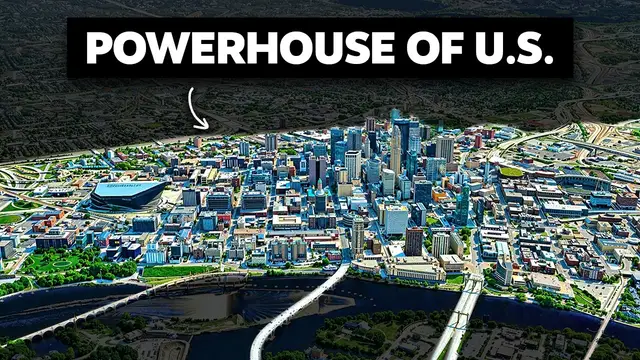
The metro has 15 Fortune 500 headquarters, the highest per-capita concentration among the 30 largest U.S. metros. They include UnitedHealth Group, Target (which kept its downtown headquarters) and U.S. Bancorp, the biggest bank in the Midwest.
No single industry dominates. Health care, finance, manufacturing, education and tech are all strong, so when one sector takes a hit, the region doesn’t fall apart the way Detroit did with cars. Big employers also tend to stay put: Mayo Clinic announced a roughly $5 billion expansion in Rochester. More in why Minneapolis is an underrated economic powerhouse.
2. Anchor institutions lock in demand
Anchor institutions are large, long-term employers rooted in a place: hospitals, universities, headquarters and government. They don’t relocate when the economy shifts, and people build their lives around them.
- The University of Minnesota has about 55,000 students on its Twin Cities campus, a major research operation and a medical school that trains hundreds of new physicians. Many graduates stay.
- Medical Alley includes more than 1,000 health and life sciences companies across Minnesota.
- Health care and education held up through 2008 and kept going through COVID, when many private-sector jobs didn’t.
That’s housing demand that doesn’t disappear in a downturn.
3. Development is rebuilding the city
Downtown Minneapolis is turning empty office space into homes:
- The old Dayton’s building (over 1 million square feet) has become a mixed-use landmark with offices, retail and a food hall.
- 150 South Fifth Street, a 400,000-square-foot office tower, is being converted to about 280 apartments.
- Target’s former downtown office space is planned to become about 500 apartments.
The North Loop shows what happens when housing, jobs, parks, retail and transit come together; it’s now the city’s top mixed-use neighborhood. Along the river, the Upper Harbor Terminal is turning 48 acres of old industrial land into an 8,000-seat amphitheater and a 20-acre park (see Upper Harbor), and the RiverFirst plan is adding trails and river access in Northeast. More in 9 megaprojects changing the Twin Cities.
4. Lifestyle you can’t copy
Minneapolis has 22 lakes and lagoons inside the city limits, over 180 parks and about 55 miles of parkways. The Chain of Lakes (Bde Maka Ska, Lake Harriet, Lake of the Isles and Cedar Lake) draws millions of visitors a year, and you can be at a lake within 10 minutes of downtown. Nearly every resident lives within a 10-minute walk of a park. The city ranks among the most bikeable in the country, and the skyway system connects about 80 downtown blocks, so you can cross downtown in January without going outside.
That’s a reason people stay even when they change jobs.
5. Homes still cost less than peer cities
Compared with Boston and Seattle, Minneapolis remains much more affordable, with a citywide median in the mid-$300,000s. By neighborhood (as of November 2025):
| Area | Typical range |
|---|---|
| Northeast Minneapolis | low $300,000s to low $400,000s |
| North Loop | high $400,000s to low $600,000s |
| Uptown | mid-$400,000s to mid-$500,000s |
| South Minneapolis near Lake Nokomis | low $300,000s to low $400,000s |
Boston sits in the $800,000s and up, Denver in the high $500,000s to $600,000s, and Seattle’s key neighborhoods top $1 million. Homeowner insurance here also typically runs well below coastal markets dealing with climate risk. Property taxes vary by city, so check them with our affordability calculator.
Home values here have generally been steady rather than boom-and-bust. Nobody can guarantee appreciation, but that steadiness is what I’d want heading into uncertain times.
The bottom line
A diverse economy, anchor institutions, smart development, lifestyle you can’t copy, and prices well below peer cities: that’s why I think Minneapolis is set up for the next decade. Thinking about moving here or upgrading? Email our team, and see where I’d live in 2026.