A Driving Tour of Lakeville, MN: Lakes, Parks, Downtowns and New Construction
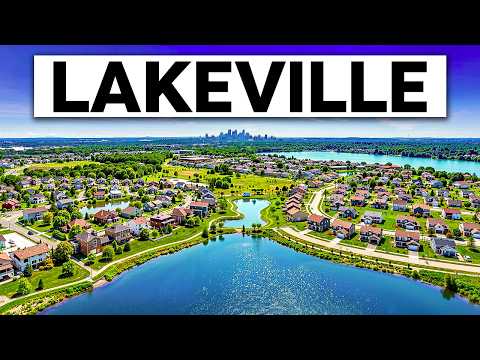
Lakeville is one of the fastest-growing cities in Minnesota, and it’s my hometown. When my parents moved here in the early ’70s, most roads were dirt and there wasn’t a single stoplight. Here’s a driving tour through the lakes, parks, downtowns and new neighborhoods.
Details are as of my video above (February 2026). Also see why Lakeville is the most underrated suburb.
Growth
Lakeville went from about 60,000 people in 2020 to about 70,000 by 2025, with about 80,000 projected by 2030. It’s geographically huge, and long-range projections suggest it could someday be among the largest cities in the state. Until about 15 years ago, the city didn’t allow big-box stores. Now you’ll find three Cub Foods, a SuperTarget, Walmart, Fleet Farm, a Cracker Barrel and an Amazon fulfillment center, so you rarely need to leave town.
The median sale price was in the upper $500,000s (about $580,000), with single-family homes from the low $300,000s for ones needing work up to multiple millions, and more new construction permits than any other Twin Cities city.
Orchard Lake
The Chart House, one of Lakeville’s longest-standing restaurants, sits on a small lake next to Orchard Lake, with a big patio, live music, weddings and a great Sunday brunch. Nearby, the railroad bridge featured in some Prince-era scenes has since been filled in.
Homes on Orchard Lake rarely change hands, sometimes only a couple a year, and mostly range from about $800,000 to $1.5 million, many built from the mid-’50s to mid-’80s, with some teardowns and infill. It’s a full-recreation lake (tubing, jet skis and boating) known for muskie, and it’s quieter than Lake Marion. A single road circles it, and Orchard Lake Park has a beach, playground, grills, mature oaks and fishing docks. Just west is Murphy-Hanrehan Park Reserve, with horse trails and extensive mountain bike trails.
The “new downtown” along County Road 50
Strip centers, redevelopment and big-box stores along County Road 50 and Kenwood Trail (County Road 5), which runs diagonally through town. I-35 is nearby (it splits into 35W and 35E to the north), but unless you’re right next to it, there’s little freeway noise. Lakeville is far enough from MSP that airplane noise is usually light, though wherever you buy, check flight paths and noise maps.
Lake Marion and Ritter Farm Park
Lake Marion is the biggest and busiest of Lakeville’s three lakes (with Orchard and Crystal), and I grew up on it, taking our boat under the I-35 bridges. It’s relatively clean with good fishing for walleye, panfish, northern pike, and largemouth and smallmouth bass.
- Ritter Farm Park, on Lake Marion’s shore, is a low-key gem: a dirt road in under 100-year-old oaks, a dog park, picnic areas, apple and chokecherry picking, an archery range, an environmental learning center, trails and a hilltop view of the lake.
- Casperson Park has soccer fields, grills and a band shelter, and it’s the northwest trailhead for the lake.
- Juno Trail, once a gravel road, is now a walking path along the west shore of roughly a mile and a half.
- Antlers Park was completely redone, with probably the best beach in town and Lakeville Brewing in summer.
Lake Marion homes rarely sell; most fall around $1.5 million to $2 million, and the most expensive sold for almost $4 million. Trails are plowed in winter, and almost everywhere you look there’s another park.
Restaurants
Porterhouse for steak and seafood, Teresa’s (my favorite Mexican restaurant, which caters our client event every year the Monday before Thanksgiving), and the downtown spots below. Fun fact: Lakeville’s liquor stores are city-owned, and proceeds help support city initiatives.
Historic downtown
Dating to the late 1800s, downtown went from almost a ghost town to bustling again: Alibi, Baldy’s BBQ and Baldy’s Tailgate, Babe’s, B52 Burgers and The Better Half, the original fire station, and the Lakeville Area Arts Center in a former church. Pan-O-Prog celebrates the city’s progress every summer.
Airlake Industrial Park
Airlake has an airport, active rail lines and a huge concentration of warehouses and light industrial buildings, plus big car dealerships. Its commercial tax base helps keep residential taxes lower than in many neighboring cities, and it helps pay for all those parks and trails. A mile south or east, you’re in farm country.
Cedar Avenue: the new-construction corridor
Cedar Avenue (County Road 23) runs all the way to Minneapolis. Within about half a mile on either side in Lakeville is where most new construction is happening: townhomes and single-family homes from national and regional builders, mostly entry-level and move-up rather than executive homes, often around $600,000 to $800,000 for single-family. Higher-end new homes tend to be near the lakes, like The Preserve.
The bottom line
Lakeville has planned its infrastructure for decades, and it shows: lakes, parks, trails, shopping, an industrial tax base, and easy access to the airport (15 to 25 minutes) and both downtowns. It’s not just a bedroom community. Thinking about Lakeville? Reach out.