Why Minneapolis Is Growing Backwards: The Outer-Ring Suburbs Are Winning

Minneapolis keeps showing up on fastest-growing-metro lists. But the city itself is actually losing people, while the counties around it are booming. Here’s why, where the real growth is, and what it means if you’re buying.
Figures are as of my video above (May 2026).
Big isn’t the same as growing
Hennepin County is Minnesota’s most populous county, with more than 1.27 million people, and Minneapolis sits in the middle of it. But size and growth are two different things.
Minneapolis had about 430,000 people in 2020 and an estimated 428,500 in 2024: basically flat, slightly down. Hennepin County’s overall number looks fine only because suburbs inside it, like Maple Grove, Rogers and Dayton, are growing. Ramsey County (Saint Paul) is also near zero growth, and the state demographer projects continued decline there through 2035.
Where the growth is
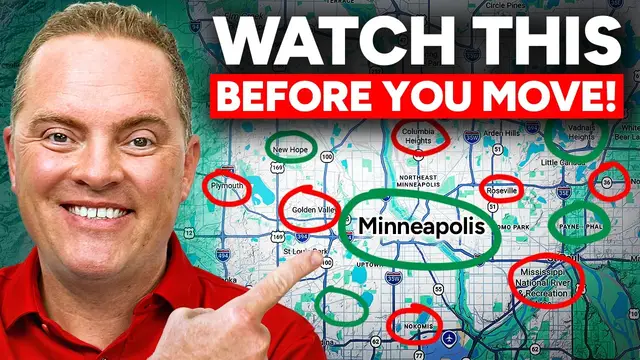
On a growth map, the brightest counties are the outer ring:
- Scott County (Shakopee, Prior Lake, Savage): up more than 20% since 2010, one of the fastest-growing counties in the country.
- Carver County (Chanhassen, Chaska, Waconia): up about 25% since 2010, with one of the highest median household incomes in the state.
- Dakota County (Lakeville, Apple Valley, Eagan, Burnsville): the third most populous county, still adding residents.
- Wright and Sherburne counties, farther out. Wright County alone added more than 13,000 residents since the 2020 census, about 9%.
Why it’s happening
- Geography. Minneapolis and Saint Paul are boxed in by the Mississippi, the lakes and protected parkland. The core is built out; new construction there is mostly teardowns. Builders who want to build at scale go where the land is.
- Downtown is shrinking as a job center. Target reportedly paid nearly $110 million to exit its lease at the 51-story City Center tower, which now has nearly a million square feet empty. When employers pull back, demand around downtown shifts. That’s not happening everywhere: in Charlotte and Raleigh, cities and suburbs are growing together.
- What buyers want: space, yards and new construction, which the city can’t offer. The trade-off is a 30- to 45-minute drive downtown.
What it means for buyers
A lot of people default to Minneapolis because it’s the name they recognize. City prices were up about 6% over the year, but much of that comes from tight inventory, not population growth. In the outer ring, growth drives demand, demand drives appreciation, and new amenities, tax base and infrastructure follow.
The mistake we see: someone relocating Googles Minneapolis, loves the lakes and walkability, and pays a premium for an older home or condo in the city. Meanwhile, buyers who did their homework bought newer homes on bigger lots in Lakeville, Chaska, Shakopee or Prior Lake, and a few years later, they often have more equity.
Minneapolis still has a ton going for it, with the Chain of Lakes, Minnehaha Falls, the arts and the hospitals, and for some buyers, city living is the right move. But for buyers focused on long-term equity, the data points outward.
What it costs (spring 2026)
- Lakeville: starting around the mid-$400,000s
- Chanhassen: mid to high $500,000s
- Shakopee and Apple Valley: high $300,000s to mid-$400,000s
- Elk River and Big Lake (Sherburne County): low $300,000s to mid-$400,000s
Metro inventory was about 2.3 months of supply, so there’s still competition, but growth is on these buyers’ side. You can still find new construction at prices that make sense.
The bottom line
Buy where the growth is going, not where it’s already been. The outer ring isn’t the backup plan; it’s the strategy. Want help figuring out which area fits you? Email our team, or search homes on the map. And if you’re relocating, read about popular suburbs that surprise out-of-state buyers.