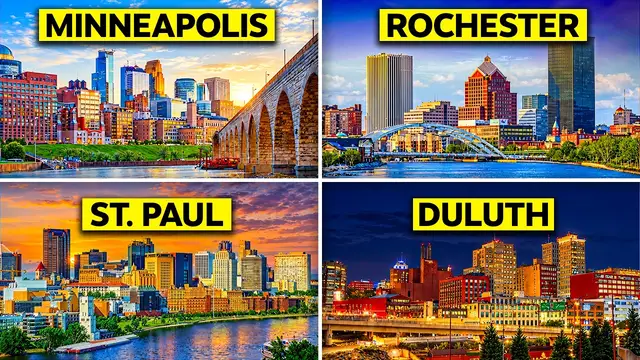
Saint Paul vs. Minneapolis: Which One Fits Your Life?

Most people treat Minneapolis and Saint Paul like the same city. That mistake can cost buyers $50,000 or more for the same square footage, or an extra hour of commuting every day. Here’s how they really compare, so you can pick the one that fits how you actually live.
Figures are as of my video above (February 2026).
Vibe and identity
They sit side by side but feel like two different cities. I describe Minneapolis as more Times Square and Saint Paul as more Boston.
Minneapolis (about 428,000 people) is bigger, busier and more modern, and it’s always changing. Downtown is the region’s main business hub, and the skyway connects about 80 blocks with more than 10 miles of indoor walkways. Downtown splits into distinct pockets: the theater district, the business core, the Warehouse District and North Loop (warehouses turned lofts and restaurants), and the Mill District and Downtown East by the river.
Saint Paul (just over 300,000) is slower, quieter and more traditional, neighborhood-based, with less turnover. It’s the state capital, and Summit Avenue stretches about 4.5 miles with one of the longest preserved runs of Victorian homes in the country, with ties to F. Scott Fitzgerald and the Governor’s Residence. Como Zoo is free, and the Minnesota History Center and other institutions are woven into the city.
Neighborhoods and walkability
Minneapolis ranks #2 in the country for bike-friendliness, with a citywide Walk Score around 71, and some neighborhoods much higher: Lyn-Lake about 96, Downtown West about 93, with Uptown and Lowry Hill East close behind. Northeast is an arts hub; the Northrup King Building has more than 350 artists and tenants, and Art-A-Whirl happens every May.
Saint Paul’s neighborhoods are more clearly defined and residential, with older street layouts. Irvine Park is a preserved Victorian enclave around a small park. Downtown is quieter but has CHS Field (Saints baseball) and newer housing often priced below downtown Minneapolis. Lowertown has warehouse lofts, galleries, the farmers market and Union Depot.
Home prices
Minneapolis offers more variety (condos, apartments and new builds), and prices can jump block to block. The city median was in the mid-$300,000s, but:
- North Loop: low to mid-$500,000s, for walkability and downtown life
- Linden Hills: 1920s to 1950s homes near the lakes, from the high $600,000s to well into the $800,000s
- Longfellow: quieter and residential, low to upper $300,000s, with parks and trails nearby
- Powderhorn: often mid-$200,000s to low $300,000s
Saint Paul has more single-family and older homes, with steadier prices; the median was closer to the mid-$290,000s. Neighborhoods feel settled, without the block-to-block jumps. Minneapolis gives you variety; Saint Paul gives you consistency.
Cost of living and taxes
You could pay around $4,500 a year in property taxes in either city, but in one it might be on a $350,000 condo and in the other on a $300,000 house with a yard. Minneapolis averages about 1.3% of value (the national average is about 1.02%), with most owners paying roughly $4,600 to $4,900 a year, and an 8% levy increase was approved for 2026. Saint Paul’s tax rates are similar, but you often start at a lower price. The Twin Cities overall run about 6% to 7% below the national cost of living. One perk: Minnesota doesn’t charge sales tax on clothing or shoes.
Jobs and getting around
Minneapolis has more big job centers: Target, U.S. Bank and Xcel Energy downtown, and Best Buy in nearby Richfield. The Blue Line runs about 12 miles from downtown to the airport and Mall of America (about 28 minutes from the airport to Target Field), the Green Line links both downtowns through the University of Minnesota, and the Green Line Extension to the southwest suburbs is expected in 2027.
Saint Paul leans toward government, health care and education, including the Capitol, 3M (in Maplewood) and hospitals like Regions and United. Commutes within Saint Paul tend to feel shorter. With the Green Line, many people live in one city and work in the other.
Food, culture and sports
Minneapolis has the bigger, faster scene: First Avenue, nearby Paisley Park, Juicy Lucys at Matt’s or the 5-8 Club, Vietnamese at Quang, Spoon and Stable in the North Loop, breweries in Northeast, plus the Vikings, Twins, Timberwolves and Lynx.
Saint Paul is calmer and more local: favorite spots you return to, the History Center, the Science Museum and the Fitzgerald Theater, plus the Wild at Grand Casino Arena and Minnesota United (and women’s pro hockey) nearby.
The outdoors
Minneapolis is all about the lakes: 180-plus parks, 50-plus miles of trails and parkways, Bde Maka Ska, Lake Harriet and Lake of the Isles, the Grand Rounds, Theodore Wirth Park and Minnehaha Falls. It’s active and social.
Saint Paul leans toward river views and bluffs, with fewer crowds: free Como Park Zoo and Conservatory, and Harriet Island on the Mississippi.
Who fits where
Minneapolis fits people who want energy around them: walkable neighborhoods, busy nights, lots of places to eat and drink, and condos or newer homes.
Saint Paul fits people who want a calmer pace, older and tight-knit neighborhoods, and to stay put and know their neighbors, and it’s great if you work in government, health care or education.
And you don’t have to choose forever: the Green Line connects both downtowns. The biggest mistake I see is picking the city that sounds better instead of the one that matches your normal week. Email our team and we’ll help you find the neighborhood that fits your commute, budget and lifestyle. Also read Saint Paul pros and cons.