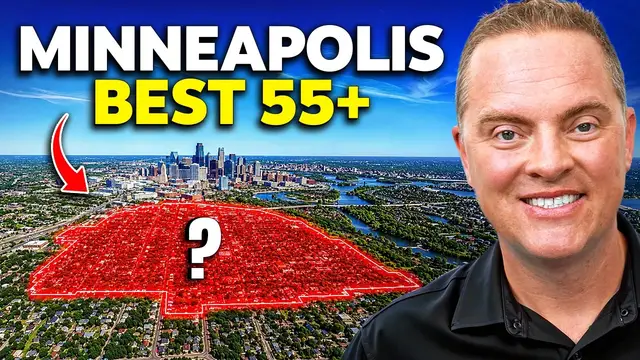
Why Minneapolis Is the Opposite of Every Other Major U.S. City

The Twin Cities have more Fortune 500 companies per person than New York, Chicago or San Francisco, but you’d never guess it from the skyline. That’s your first clue: Minneapolis works differently from other big cities. If you’re thinking about moving here, understand the map before you start looking.
1. Downtown isn’t the prize
In New York, San Francisco, Boston and Chicago, downtown drives value. The closer you get, the more you pay, and moving out usually means more space for less money.
Minneapolis flips that. Some of the strongest prices are west of the city, in Edina, Wayzata, Minnetonka and around Lake Minnetonka. When I made the video above (June 2026), downtown condos could sit for months while good suburban homes were gone in hours. Edina’s average home value was in the high $500,000s, and the Lake Minnetonka area was closer to $1 million, nearly three times the metro median. Many major employers have also chosen the suburbs.
2. The suburbs are the destination
In many metros, suburbs are bedroom communities: you drive in, drive out and sleep there. Here, many suburbs have their own downtowns, their own character and often their own lakes.
- Edina has been a sought-after address for decades, with tree-lined streets and walkable shops around 50th & France.
- Wayzata has a small-town lakefront feel, with local boutiques, waterfront restaurants and direct access to Lake Minnetonka. True lake access can start well into the millions.
- Minnetonka is more spread out and residential; new construction near the lake can reach multiple millions.
- Plymouth was ranked the #1 place to live in Minnesota by U.S. News (#31 nationally), about 20 minutes from downtown.
- Maple Grove ranked #2 in Minnesota (#54 nationally), and homes there move fast.
3. The whole metro is built around winter
Yes, it’s cold. January highs average around 15°, the area gets about 54 inches of snow a year, and snow season can run from late October to mid-April. But instead of hiding from winter, Minneapolis built around it.
- The skyways started in the early 1960s with one bridge between two buildings. Today they stretch over 10 miles and connect more than 80 blocks, all indoors and climate controlled.
- Outdoor rinks in the parks are lit at night, and many are free. Theodore Wirth Park has groomed cross-country ski trails, and people walk, fat-tire bike and skate all winter.
- The City of Lakes Loppet started as one ski race in the early 2000s and is now a weekend festival that closes a parkway so skiers and bikers can cross.
What it means for your home search: winter changes what people value. Heated garages (ideally with a floor drain for the snowmelt), mudrooms (common in homes built since the early ’90s), energy-efficient windows, good insulation and newer mechanicals all add real value here. If you’re relocating from somewhere warm, factor them in. They’re not extras.
4. Water is a lifestyle, not a backdrop
In New York, San Francisco, Chicago or Seattle, waterfronts started as industry. Minneapolis has that history too (the Mississippi powered the mills by St. Anthony Falls), but today the pull is the lakes.
The Chain of Lakes, plus Lake Nokomis, covers about 1,500 acres of public parkland inside the city, with paths around every lake that anyone can use year-round. Minneapolis ranked #3 in the country in the Trust for Public Land’s 2026 ParkScore. People walk Lake Harriet in the morning, bike Bde Maka Ska on Saturdays, sail on Cedar Lake in June and skate on Lake of the Isles in January.
The lake neighborhoods, such as Linden Hills near Lake Harriet and Kenwood and East Isles near Lake of the Isles, are some of the most competitive places to buy in the Twin Cities.
Then there’s Lake Minnetonka: over 14,000 acres and more than 120 miles of shoreline. The median list price around the lake was over $1 million, with prime shoreline well into the multiple millions. It saw hundreds of sales last year, sales were up, and distressed listings were almost zero. It’s one of the most stable markets in the metro. (See our lake homes page.)
5. Two cities, and a ring of suburbs with their own pull
Most people moving here think they’re choosing between Minneapolis and Saint Paul. Really, they’re choosing a whole metro.
- Minneapolis is the modern business center, with corporate offices, stadiums, more arts and nightlife, and the park system.
- Saint Paul is older and more historic, and it’s the state capital. Summit Avenue is the longest preserved stretch of Victorian-era homes in the country, with nearly 375 original homes along about 4.5 miles. Cathedral Hill and Irvine Park feel quieter and full of older architecture.
But neither downtown is where most demand is. Suburbs like Maple Grove, Plymouth and Eden Prairie were seeing homes sell in about four to five weeks, often close to full price. Downtown Minneapolis condos could sit for months and sell at real discounts, and downtown Saint Paul condos were sitting even longer.
The better question
People moving to a big city usually ask, “What’s the best neighborhood near downtown?” Here, the better question is which area fits your life, because much of the real demand is in the suburbs. If you’re planning a move, tell us what you’re looking for and we’ll help you find communities that match.